Speak to Your Clients, Not at Them, With Business Communication Clarity
Why Expertise Can Create Distance in Business Communication
Most entrepreneurs don’t struggle because they lack expertise.
They struggle because business communication clarity gets lost once they forget what it felt like before they had it.
When someone has spent years mastering a craft, their language naturally evolves. Acronyms replace explanations. Frameworks replace stories. Industry shorthand replaces curiosity. And without realizing it, communication shifts from being inviting to instructional.
The intention is helpful.
The impact often isn’t.
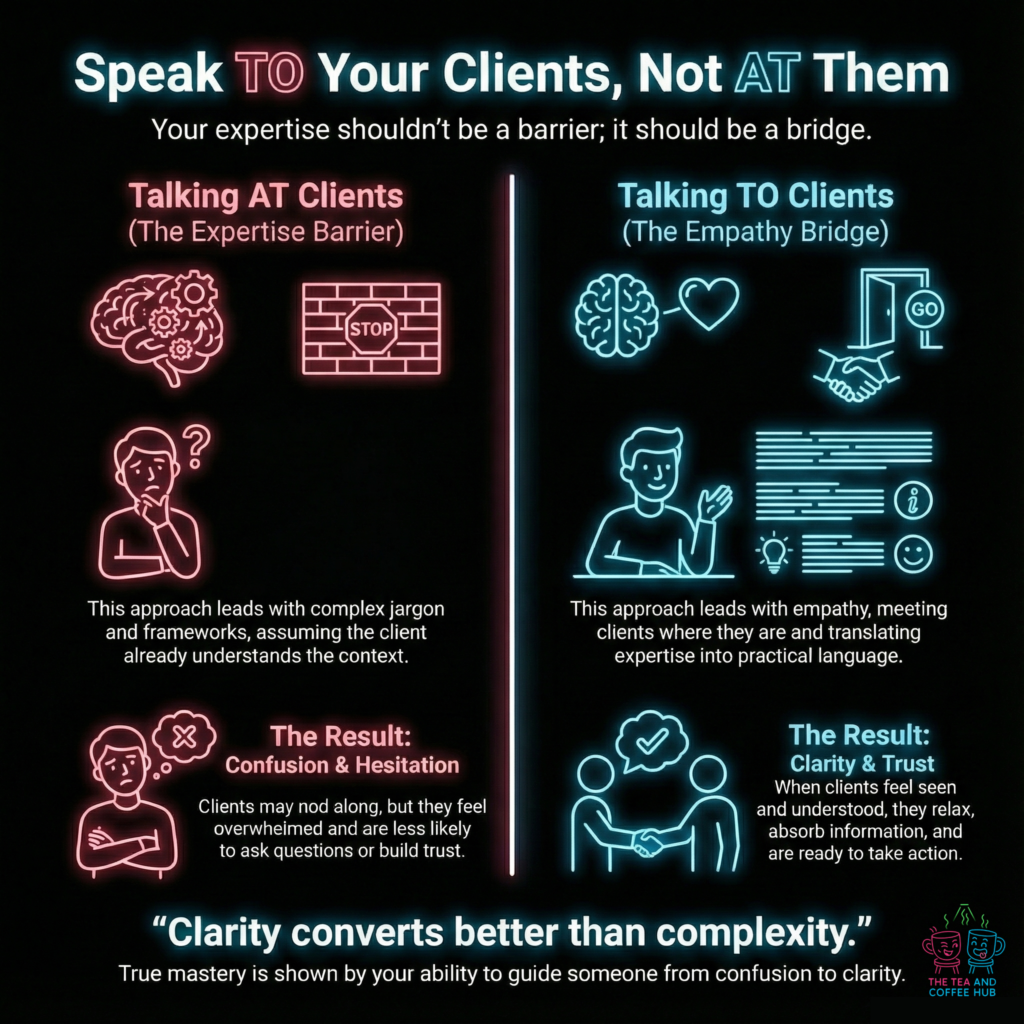
When Expertise Becomes a Barrier
Experience creates efficiency, but it can also create blind spots.
Entrepreneurs who live inside their work every day start assuming shared understanding. They explain solutions without fully grounding the problem. They move quickly to strategy while the client is still orienting themselves.
What feels like clarity to the expert can feel like overwhelm to the client.
This isn’t arrogance.
It’s familiarity.
And familiarity changes how we speak.
Clients Don’t Need to Be Taught First. They Need to Be Understood.
Before a client can absorb advice, they need to feel seen.
Most people don’t arrive at a service looking for vocabulary or theory. They arrive with uncertainty, confusion, or frustration. They’re trying to describe a problem they don’t yet have language for.
When entrepreneurs lead with expertise instead of empathy, clients often experience:
Confusion disguised as agreement
Silence instead of questions
Hesitation instead of trust
They may nod along, but they don’t feel anchored.
Effective communication starts by meeting people where they are, not where the expert lives.
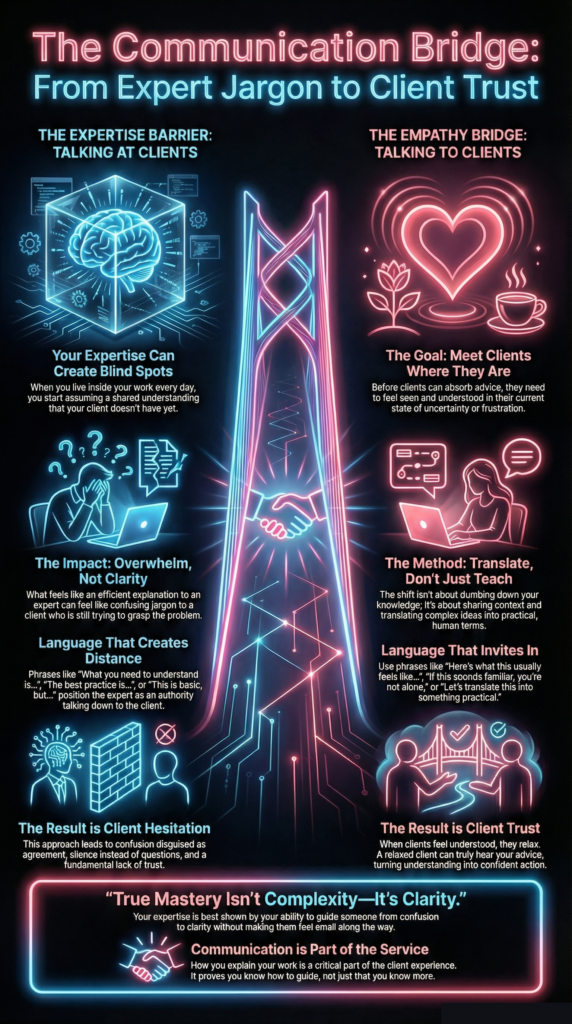
Talking “At” vs. Talking “To”
There’s a subtle but important difference between these two approaches.
Talking at clients often sounds like:
“What you need to understand is…”
“The best practice here is…”
“This is basic, but…”
Talking to clients sounds like:
“Here’s what this usually feels like before people can name it.”
“If this sounds familiar, you’re not alone.”
“Let’s translate this into something practical.”
The shift isn’t about simplifying intelligence.
It’s about sharing context.
How Business Communication Clarity Builds Client Trust And Authority
Authority is earned through clarity, not complexity.
Clients trust professionals who can:
Explain ideas without jargon
Adjust language based on who they’re speaking to
Make space for questions without judgment
When entrepreneurs translate their expertise instead of broadcasting it, something powerful happens, clients relax. And relaxed clients can actually hear what’s being said.
That’s when understanding turns into action.
Communication Is Part of the Service
How something is explained is part of the experience.
If clients feel overwhelmed before the work even begins, they’re already carrying cognitive strain. Clear, human communication reduces that load and signals leadership.
Strong communicators don’t prove they know more.
They prove they know how to guide.
The Real Measure of Expertise
True mastery isn’t shown by how advanced your language is.
It’s shown by your ability to walk someone from confusion to clarity, without making them feel small along the way.
Speak to your clients.
Invite them in.
Translate the work.
That’s how trust is built, and how businesses grow sustainably.
If your content or conversations feel like they’re not landing, it may not be a strategy problem, it may be a communication one.
Clarity always converts better than complexity.