Leading Through Change

Or, How to Stop Panicking and Start Steering the Damn Ship ☕⚡

Let’s be honest.
Change doesn’t ask permission. It kicks the door in, spills your coffee, and announces it’s staying awhile.

Leading through change isn’t optional for founders right now. New tech. Market chaos. Team reshuffles. Personal burnout hiding behind “strategic pivots.”
If you’re leading anything right now, change isn’t optional. How you handle it is.

This isn’t about pretending everything’s fine or slapping a motivational quote on a dumpster fire.
This is about leading like a grown-up when things are shifting under your feet.

Welcome to change management, Tea & Coffee style. No sugar. Just caffeine and truth.

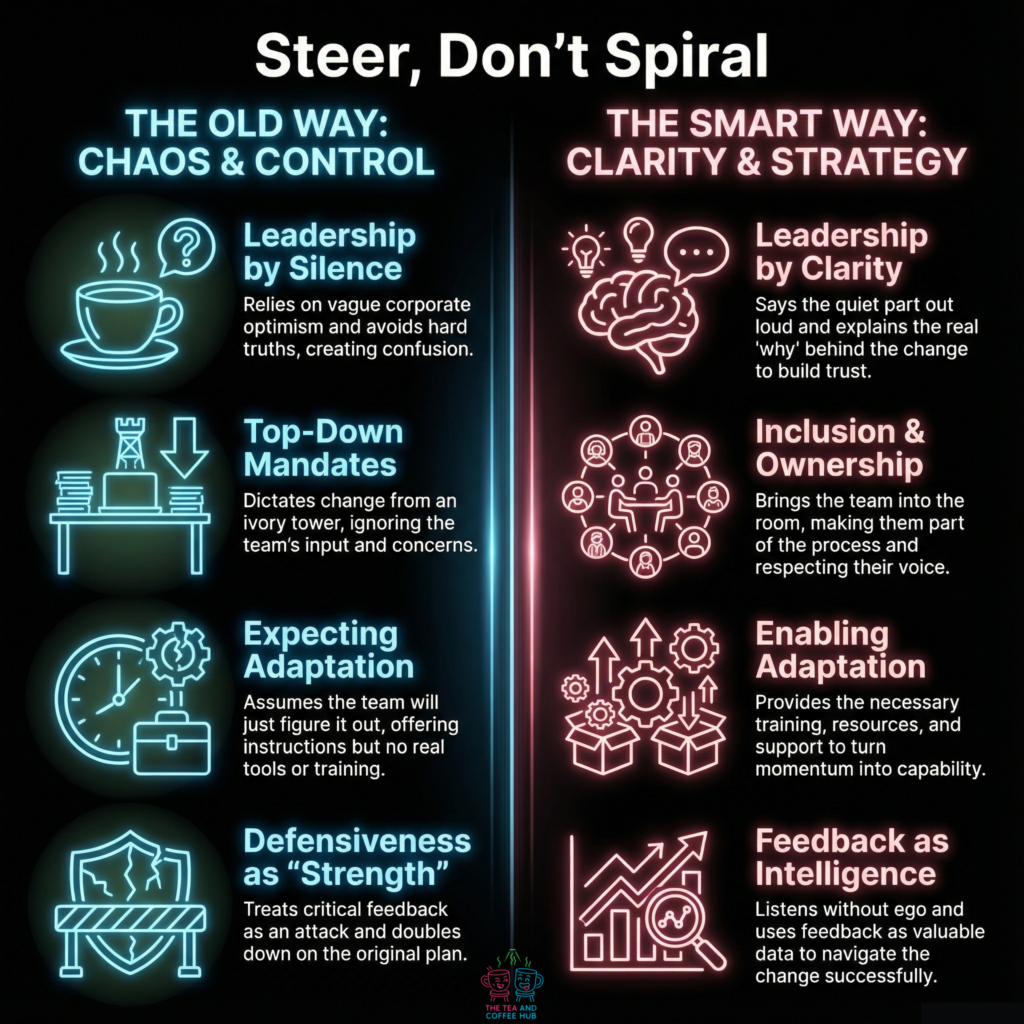
A neon-style comparison graphic titled “Steer, Don’t Spiral.” The left side shows “The Old Way: Chaos & Control,” highlighting leadership by silence, top-down mandates, lack of training, and defensiveness. The right side shows “The Smart Way: Clarity & Strategy,” emphasizing leadership by clarity, inclusion and ownership, enabling adaptation through support, and using feedback as intelligence. The design uses glowing icons, coffee imagery, and a split-screen layout.

Why Change Management Isn’t Optional Anymore

1. Stability Isn’t the Absence of Change

It’s how you hold people through it.

Strong leadership doesn’t eliminate disruption.
It creates enough clarity that your team doesn’t spiral every time the plan evolves.

People don’t need certainty.
They need context.

2. Adaptability Is a Skill, Not a Personality Trait

Your team isn’t “resistant to change.”
They’re resistant to confusion, silence, and whiplash.

When leaders normalize learning, recalibrating, and saying “this part is new for all of us,” resilience becomes contagious.

Calm leaders create calm teams.
Chaotic leaders create Slack meltdowns.

3. Engagement Lives or Dies in Transition

Most people don’t quit jobs.
They quit how change is handled.

When teams feel informed, included, and supported, they stay.
When they feel blindsided or dismissed, they update LinkedIn quietly… then loudly.

4. Goals Don’t Survive Chaos Without Leadership

Vision without guidance is just anxiety with a mission statement.

Change management is how strategy survives contact with reality.

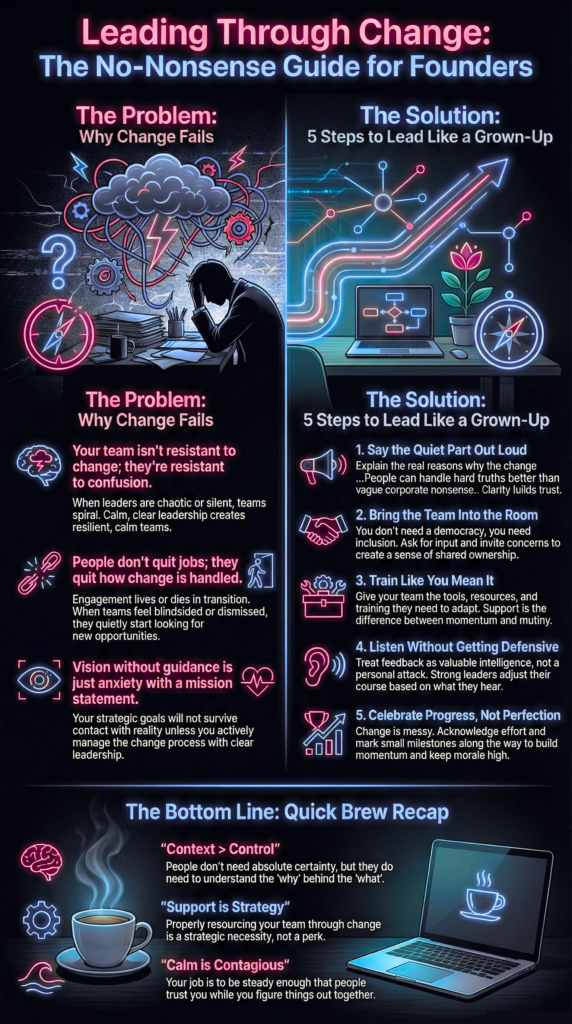
A neon infographic titled “Leading Through Change: The No-Nonsense Guide for Founders.” The left side illustrates why change fails, showing a stressed leader surrounded by chaotic symbols and text explaining confusion, disengagement, and lack of guidance. The right side outlines five steps to lead change effectively, including clear communication, team inclusion, proper training, listening to feedback, and celebrating progress. The design features glowing icons, coffee imagery, and a structured split layout.

How to Actually To be Actively Leading Through Change (Without Becoming the Villain)

1. Say the Quiet Part Out Loud

Explain why the change is happening.
Not the polished version. The real one.

People can handle hard truths.
They can’t handle vague corporate nonsense.

Clarity builds trust faster than optimism ever will.

2. Bring the Team Into the Room

You don’t need a democracy.
You need inclusion.

Ask for input. Invite concerns. Let people feel heard.
Ownership grows where voices are respected.

You’re still the leader.
You’re just not leading from an ivory tower with bad Wi-Fi.

3. Train Like You Mean It

If you expect people to adapt, give them tools.
Not just instructions.

Training, resources, coaching, documentation.
Support is not a “nice-to-have.” It’s the difference between momentum and mutiny.

4. Listen Without Getting Defensive

Feedback isn’t an attack.
It’s intelligence.

If your first instinct is to justify instead of listen, pause.
Strong leaders adjust. Weak ones double down and call it confidence.

5. Celebrate Progress, Not Perfection

Change is messy.
Waiting for flawless execution before acknowledging effort kills morale.

Mark milestones. Call out wins.
Momentum feeds motivation.


The Real Tea ☕

Leading through change isn’t about having all the answers.
It’s about being steady enough that people trust you while you figure them out.

Your job isn’t to eliminate uncertainty.
It’s to make it survivable, navigable, and eventually empowering.

So take a breath. Refill the mug.
Then lead with clarity, compassion, and just enough backbone to keep things moving.

Change is happening anyway.
You might as well be good at it.

🔥 Quick Brew Recap

  • Change isn’t the problem. Poor leadership during change is.

  • Context > Control

  • Inclusion beats intimidation every time

  • Support is strategy

  • Calm is contagious

If this hit a nerve, good. That’s growth knocking.


author avatar
Karen Hewitt CEO of Blossom To Success
Karen Hewitt is a Harvard-certified disruptive strategist, creator of the Identity-Led Archetypes™ and Disruptive Archetypes™ frameworks, and co-founder of Tea & Coffee Hub. As an AuDHD mom of five, she blends social media psychology, AI innovation, and emotionally intelligent strategy to help entrepreneurs build brands with soul, systems, and self-trust.