AI Hallucinations: When Your Business Trusts the Robot Too Much
The Hidden Risk Behind Confidently Wrong AI
Let’s start with a moment of uncomfortable honesty.
AI doesn’t “lie.”
It hallucinates.
And before you imagine robots wandering around seeing pink elephants, let’s translate that into plain founder language:
An AI hallucination happens when an AI system generates information that sounds correct but is completely fabricated or inaccurate.
The scary part?
It says it with absolute confidence.
No hesitation.
No uncertainty.
Just smooth, polished nonsense.
And right now, thousands of businesses are unknowingly publishing it.
Why AI Hallucinations Happen
Here’s the thing most marketing headlines skip.
AI models don’t actually understand information.
They predict patterns in language.
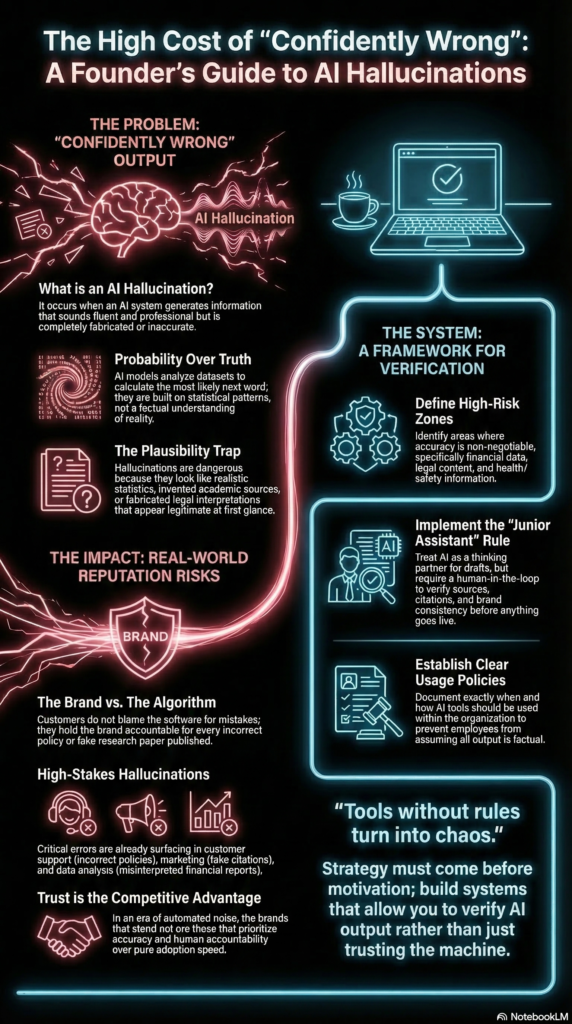
Large language models work by analyzing massive datasets and calculating the most statistically likely next word in a sentence.
That’s incredible for:
• brainstorming
• drafting content
• summarizing documents
• generating ideas
But it also means the system is built on probability, not truth.
When the model doesn’t have enough reliable data or context, it doesn’t say:
“I’m not sure.”
It tries to fill the gap.
That’s when hallucinations appear.
And because the output is written in fluent, professional language, it often looks more credible than it actually is.
The Danger of “Confidently Wrong”
If AI made obvious mistakes, this wouldn’t be a big deal.
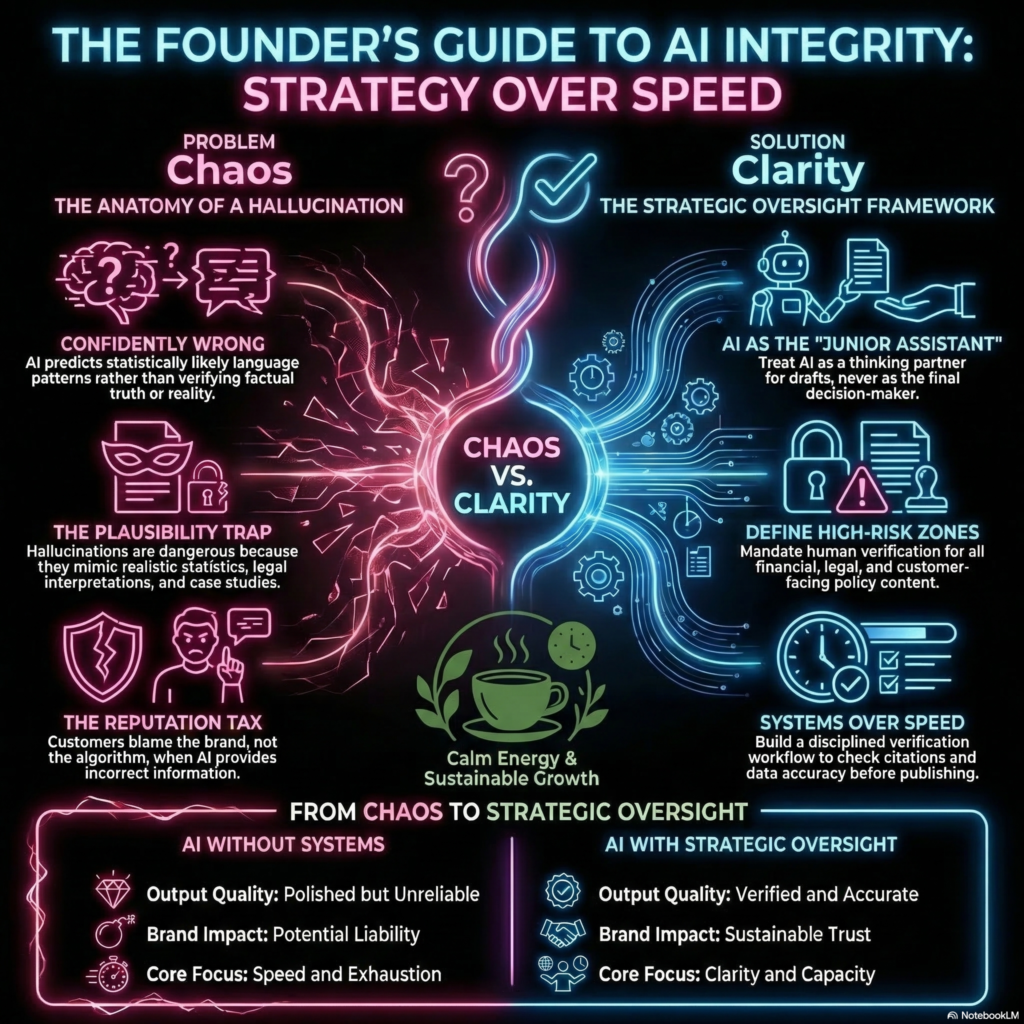
But hallucinations are dangerous because they’re plausible.
They look like:
• realistic statistics
• invented academic sources
• fabricated legal interpretations
• fake case studies
• incorrect financial conclusions
To a busy founder or marketing team, the output appears legitimate.
Until someone checks.
And sometimes, nobody does.
Real-World Examples Businesses Are Already Facing
Let’s ground this in reality.
Across industries, companies are discovering AI hallucinations in places where accuracy matters most.
Customer Support
AI chatbots giving incorrect refund policies.
Marketing Content
Blog posts citing research papers that don’t exist.
Legal Information
AI tools generating contract advice that conflicts with actual regulations.
Data Analysis
AI summaries misinterpreting spreadsheets or financial reports.
Each of these situations creates a different kind of problem.
But they all lead to the same outcome:
Loss of trust.
And in business, trust is everything.
The Reputation Risk Most Founders Aren’t Considering
When customers find incorrect information on your website or from your AI assistant, they rarely blame the software.
They blame you.
To them, the brand published the content.
The brand answered the question.
The brand made the mistake.
This is why AI hallucinations aren’t just a tech issue.
They’re a leadership issue.
Because businesses adopting AI without verification processes are essentially allowing an algorithm to speak on their behalf without supervision.
And that’s a risky spokesperson.
Why Verification Systems Matter More Than Speed
Right now there’s a race happening across industries.
Everyone wants to move faster with AI.
But the companies winning long-term aren’t the fastest adopters.
They’re the most disciplined users.
They build verification into their workflow.
For example:
Before publishing AI-generated content, they check:
• sources and citations
• data accuracy
• legal implications
• brand messaging consistency
• regulatory compliance
Think of AI like a junior assistant.
It can do incredible work quickly.
But you wouldn’t publish something written by a brand-new intern without reviewing it first.
AI deserves the same oversight.
A Practical Framework for Preventing AI Hallucinations
Businesses don’t need to stop using AI.
They just need better guardrails.
Here’s a simple starting framework.
1. Define High-Risk Areas
Identify where AI outputs must always be verified.
Examples:
• financial data
• legal content
• customer policies
• health or safety information
2. Require Human Review
Any AI-generated material used externally should pass through human oversight.
3. Train Employees on AI Limitations
Most mistakes happen because employees assume the output is factual.
Education prevents that.
4. Use AI for Drafts, Not Final Decisions
Treat AI as a thinking partner, not the decision-maker.
5. Create Clear AI Usage Policies
Document when and how AI tools should be used inside the organization.
These policies don’t slow innovation.
They protect it.
The Businesses That Win in the AI Era
Let’s zoom out for a moment.
The AI revolution is real.
But so is the credibility crisis it’s creating.
As automated content floods the internet, the brands that stand out won’t be the ones using AI the most.
They’ll be the ones using it responsibly.
Because the real competitive advantage in the next decade isn’t speed.
It’s trust.
And trust comes from accuracy, transparency, and accountability.
The Tea & Coffee Hub Takeaway ☕
AI is a powerful tool.
But tools without rules turn into chaos.
So if your company is adopting AI, ask this question:
“Do we trust the AI… or do we verify it?”
Because the difference between innovation and liability is often just one step.
Human oversight.
Entrepreneurship is where clarity and chaos share a cup of coffee.
Your job?
Make sure the robot doesn’t spill it.