The Best Marketing Question Might Be: “What Aren’t They Saying?”
The Best Marketing Question Might Be: “What Aren’t They Saying?”
The problem is, we often listen only to the words.
“I need to think about it.”
“It’s too expensive.”
“I’m not ready yet.”
“Send me some information.”
And somewhere in a sales training manual, there’s probably a perfectly polished response designed to “overcome” each objection.
But what if the objection isn’t actually the problem?
What if the better question is:
What aren’t they saying?
Because good marketing isn’t only about knowing what to say. It’s about understanding what your customers are trying to communicate.
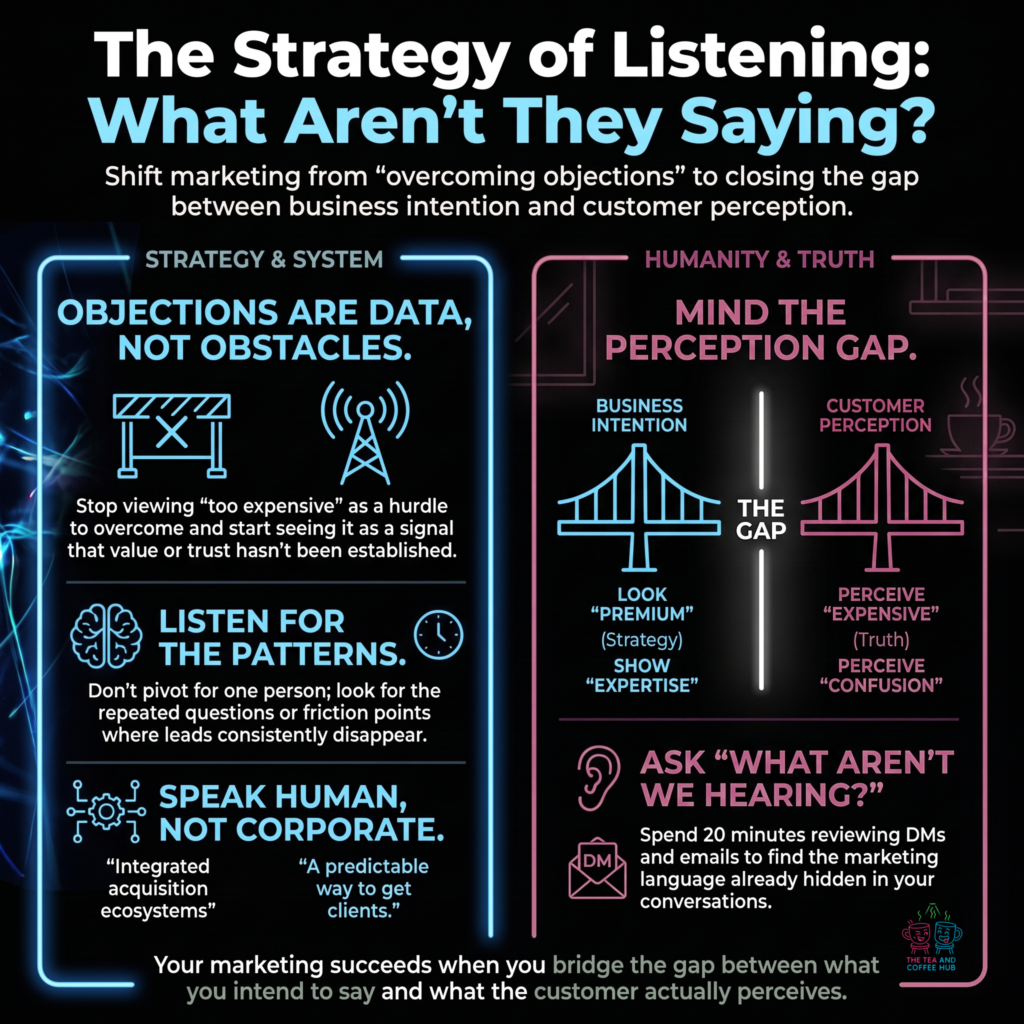
“Too Expensive” Might Not Be About Money
Think about your own buying decisions.
Have you ever looked at something you technically could afford and still thought, “That’s too expensive”?
Maybe the price wasn’t actually the problem.
Maybe you weren’t convinced it would work.
Maybe you didn’t understand exactly what you were getting.
Maybe you bought something similar before and regretted it.
Maybe you simply didn’t trust the business enough yet.
“Too expensive” was just easier to say.
Now imagine the business immediately offers you 20% off.
They’ve solved the wrong problem.
This is where listening becomes part of marketing.
Stop Trying to “Overcome” Every Objection
I don’t love the phrase overcome the objection because it immediately turns the conversation into something adversarial.
Customer raises obstacle. Business defeats obstacle. Sale accomplished.
Except there’s a human being on the other side.
An objection is information.
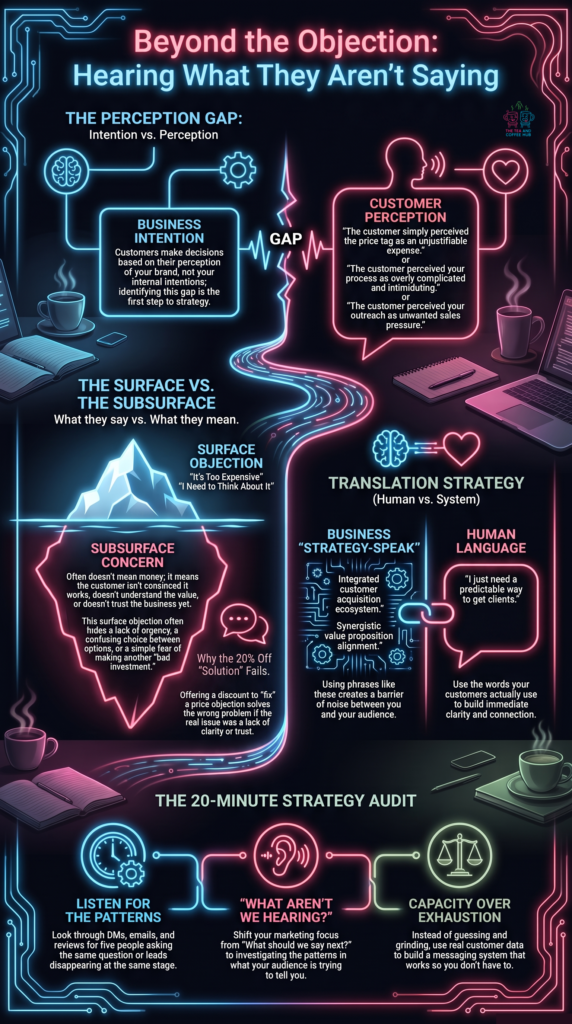
It can show you where there’s a gap between what your business intended to communicate and what your customer actually perceived.
You intended to look premium. They perceived expensive.
You intended to demonstrate expertise. They perceived complicated.
You intended to provide choices. They perceived confusion.
You intended to follow up. They perceived pressure.
That doesn’t automatically make either side wrong.
But customers make decisions based on their perception, not your intention.
That gap matters.
Get Curious Before You Assume
Take one of the most common sales responses:
“I need to think about it.”
That could mean:
“I don’t understand the difference between the options.”
“I need to ask my partner.”
“I’ve made bad investments before.”
“I don’t think this is urgent.”
“I don’t know how to say no.”
Or they might genuinely need time to think.
Those situations don’t need the same follow-up.
Instead of assuming, try asking:
“What part are you still thinking through?”
Or:
“Is there anything that still feels unclear?”
You’re not pressuring them. You’re creating room for an actual conversation.
And what you learn from those conversations can make your marketing dramatically better.
Your Customers Are Giving You Marketing Language
Businesses frequently describe their services using language their customers would never use.
You might call something:
“An integrated customer acquisition ecosystem.”
Your customer says:
“I just need a predictable way to get clients.”
There’s your marketing lesson.
Pay attention to how customers describe their problems, what they’ve tried, what frustrates them, what they’re worried about and what they want instead.
You don’t need to manipulate their words.
You need to understand them.
And don’t rebuild your marketing because one person said something. Look for patterns.
If five prospects ask the same question, pay attention.
If people repeatedly misunderstand the same part of your offer, pay attention.
If leads keep disappearing at the same point, pay attention.
They’re telling you something.
Try This Before Your Next Marketing Campaign
Before deciding what your audience needs to hear next, spend 20 minutes looking through recent emails, DMs, reviews, comments, FAQs or sales conversations.
Ask three questions:
What are people saying repeatedly?
Where does their language differ from ours?
What might they actually be trying to tell us?
Then use those patterns to shape your messaging.
Because businesses spend an enormous amount of time asking:
“What should we say?”
Sometimes the smarter marketing question is:
“What aren’t we hearing?”
Your next great piece of marketing might already be sitting inside a conversation you’ve had five times.
You just have to listen differently.
Want another perspective on what your customers might be telling you?
That’s exactly the kind of conversation the Tea & Coffee Hub Accountability Group was built for. Bring the question, the messy middle, or the thing that isn’t converting, and get another set of eyes on what you might be too close to see.
Brewing clarity. Spilling chaos. Demanding action.