AI Without AI Oversight Framework Is a Leadership Problem: The Hidden Risk of AI Adoption
If your company’s AI is running wild, the issue isn’t the technology. It’s the leadership.
Let’s rip the Band-Aid off.
Most businesses talking about AI right now are obsessed with speed.
Faster marketing.
Faster reports.
Faster customer responses.
Faster content production.
And sure — AI delivers speed like a double espresso.
But here’s the uncomfortable truth founders need to hear:
Speed without oversight creates chaos.
When companies adopt AI tools without clear governance, verification systems, or internal policies, the technology doesn’t become a productivity tool.
It becomes a liability generator.
And the responsibility for that doesn’t sit with the algorithm.
It sits with leadership.
The AI Adoption Trap: Fast Before Smart
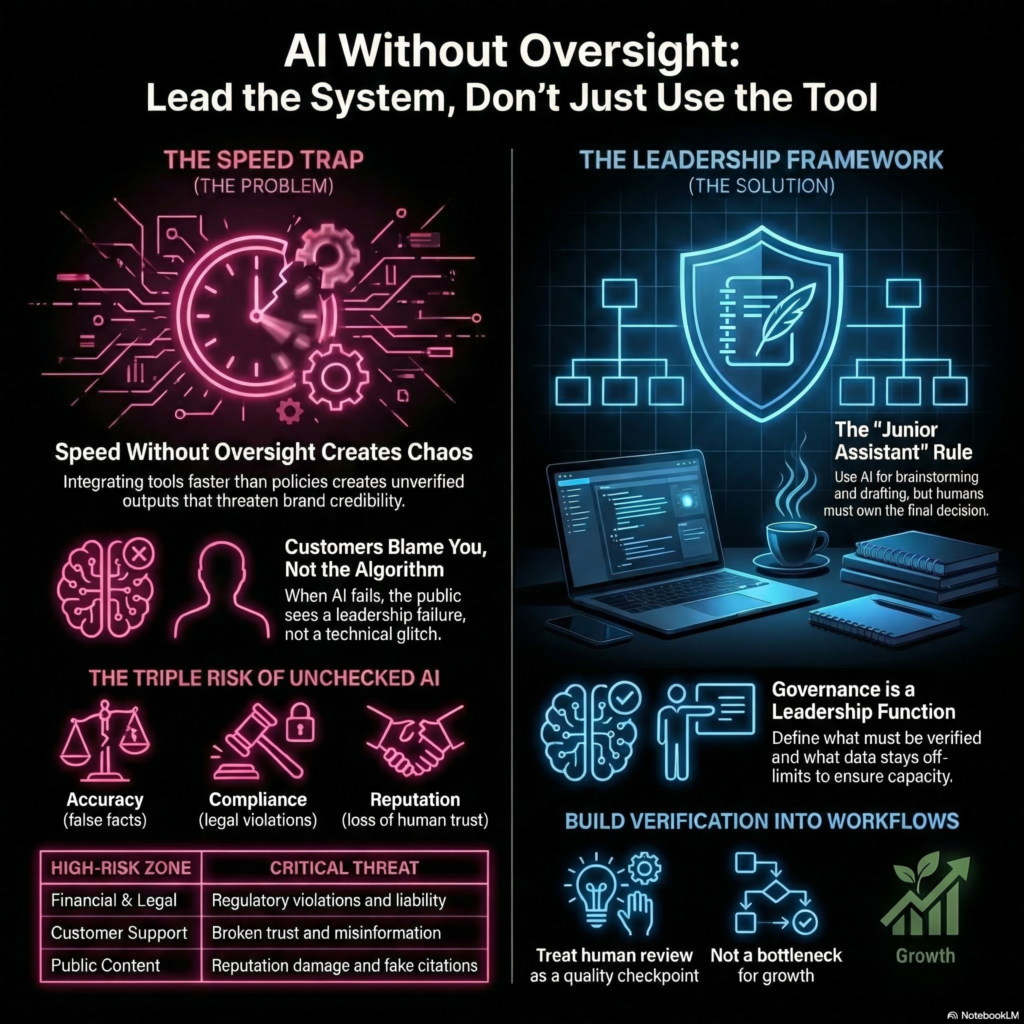
Across industries, companies are integrating AI tools into daily workflows faster than they’re building policies to manage them.
Employees are using AI to:
• draft marketing content
• summarize financial reports
• generate legal explanations
• respond to customers
• build internal documentation
The problem?
Many organizations have no guardrails for how AI should be used.
No verification requirements.
No risk classifications.
No policies for high-stakes content.
Which means decisions that affect customers, compliance, and brand credibility are sometimes being influenced by unverified machine-generated output.
That’s not innovation.
That’s automation without accountability.
When AI Fails, Customers Don’t Blame the AI
One of the biggest misconceptions about AI adoption is this:
“If the tool makes a mistake, people will understand.”
No.
Customers don’t blame the software.
They blame the company that used it.
If a chatbot gives the wrong refund policy…
If your blog publishes fake research citations…
If AI-generated legal content misrepresents regulations…
The public doesn’t say:
“Wow, that algorithm really messed up.”
They say:
“That company can’t be trusted.”
And trust, once broken, is incredibly difficult to rebuild.
The Leadership Responsibility Most Companies Ignore
Technology decisions are never purely technical.
They’re leadership decisions.
Because every tool introduced into an organization changes how people work, communicate, and make decisions.
If leadership introduces AI without answering these questions, they’re leaving risk on the table:
• What types of work can AI assist with?
• What information must always be verified by humans?
• What data should never be entered into AI systems?
• Who is accountable for reviewing AI-generated outputs?
• How do we prevent misinformation from being published?
These are governance questions.
And governance is a leadership function, not a technical one.
The Three Risks of AI Without Oversight
Let’s break down what actually happens when organizations skip AI governance.
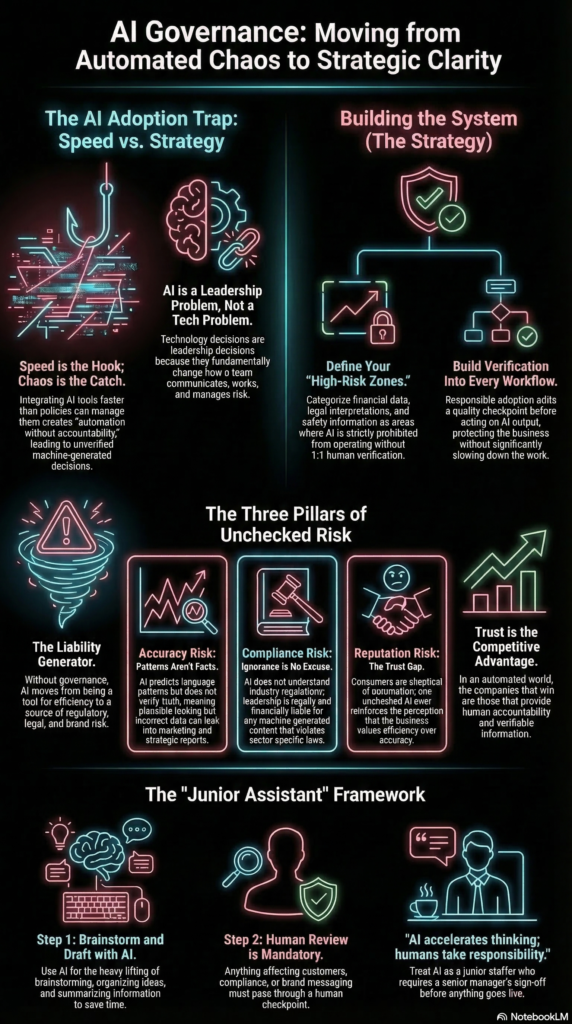
1. Accuracy Risk
AI models predict patterns in language.
They do not verify truth.
That means they can generate plausible but incorrect information that looks completely legitimate.
Without oversight, those mistakes can end up in:
• published marketing content
• customer communications
• strategic reports
One unchecked output can create public credibility problems.
2. Compliance Risk
Industries like finance, healthcare, and law operate under strict regulatory frameworks.
AI-generated content that misunderstands or misrepresents those rules can expose companies to:
• regulatory violations
• legal liability
• financial penalties
AI doesn’t understand compliance.
Leadership must.
3. Reputation Risk
This is the most underestimated threat.
The internet already has a trust problem.
Consumers are becoming more skeptical of automated content, chatbots, and AI-driven communication.
When companies publish incorrect information because they relied on AI without verification, it reinforces the perception that businesses value efficiency over accuracy.
And reputation damage spreads faster than any algorithm.
The “Junior Assistant” Rule
One of the smartest frameworks emerging in responsible AI adoption is simple:
Treat AI like a junior assistant, not an executive decision-maker.
AI can help with:
• brainstorming
• drafting content
• organizing ideas
• summarizing information
But anything that affects customers, compliance, or brand messaging should always go through human review.
Because while AI can accelerate thinking…
Only humans can take responsibility for it.
What Smart Leaders Are Doing Instead
Businesses that are adopting AI successfully aren’t just installing software.
They’re building systems.
Here are the practices responsible leaders are implementing.
Define High-Risk Zones
Certain types of information should always require human verification.
Examples include:
• financial data
• legal interpretations
• health or safety information
• official policies
Establish Clear AI Usage Policies
Employees should know exactly:
• when AI can be used
• when it cannot
• what data is off limits
• what must be reviewed
Clarity prevents careless mistakes.
Train Teams on AI Limitations
Most AI errors happen because employees assume the output is factual.
Education solves that.
When teams understand that AI predicts language patterns rather than verifying facts, they naturally approach it more critically.
Build Verification Into Workflows
Responsible AI adoption doesn’t slow work down.
It simply adds a quality checkpoint before publishing or acting on AI-generated information.
That checkpoint protects the business.
The Companies That Will Win the AI Era
AI is not going away.
It will reshape industries, workflows, and how businesses operate.
But the companies that thrive in this new landscape won’t be the ones that use AI the fastest.
They’ll be the ones that use it most responsibly.
Because when automation increases, the real competitive advantage becomes something surprisingly human:
trust.
Trust in your information.
Trust in your communication.
Trust in your leadership.
And trust doesn’t come from speed.
It comes from accountability.
The Tea & Coffee Hub Takeaway ☕
AI isn’t the risk.
Unsupervised AI is.
Tools without rules turn into chaos.
And if your organization is letting AI make decisions without oversight, the problem isn’t the technology.
It’s leadership.
Entrepreneurship is where clarity and chaos share a cup of coffee.
Your job as a leader?
Make sure the robot doesn’t run the café.