Motivation vs Systems: Why Motivation Fades and Systems Don’t for Small Business Owners
Why Motivation Fades and Systems Don’t (And What That Means for Your Business)
When it comes to motivation vs systems, most small business owners are taught to push harder instead of building support that actually sustains growth.
Most small business owners don’t lose momentum because they stop caring.
They lose momentum because they’re relying on motivation to carry work that should be carried by systems.
Motivation is emotional.
Energy fluctuates.
Life intervenes.
But businesses that last aren’t built on how someone feels on a Tuesday morning. They’re built on structures that keep things moving even when motivation dips.
This is where most advice goes wrong. It tells you to push harder, recommit, or “find your why” again.
But the issue usually isn’t desire.
It’s architecture.
The Motivation Myth
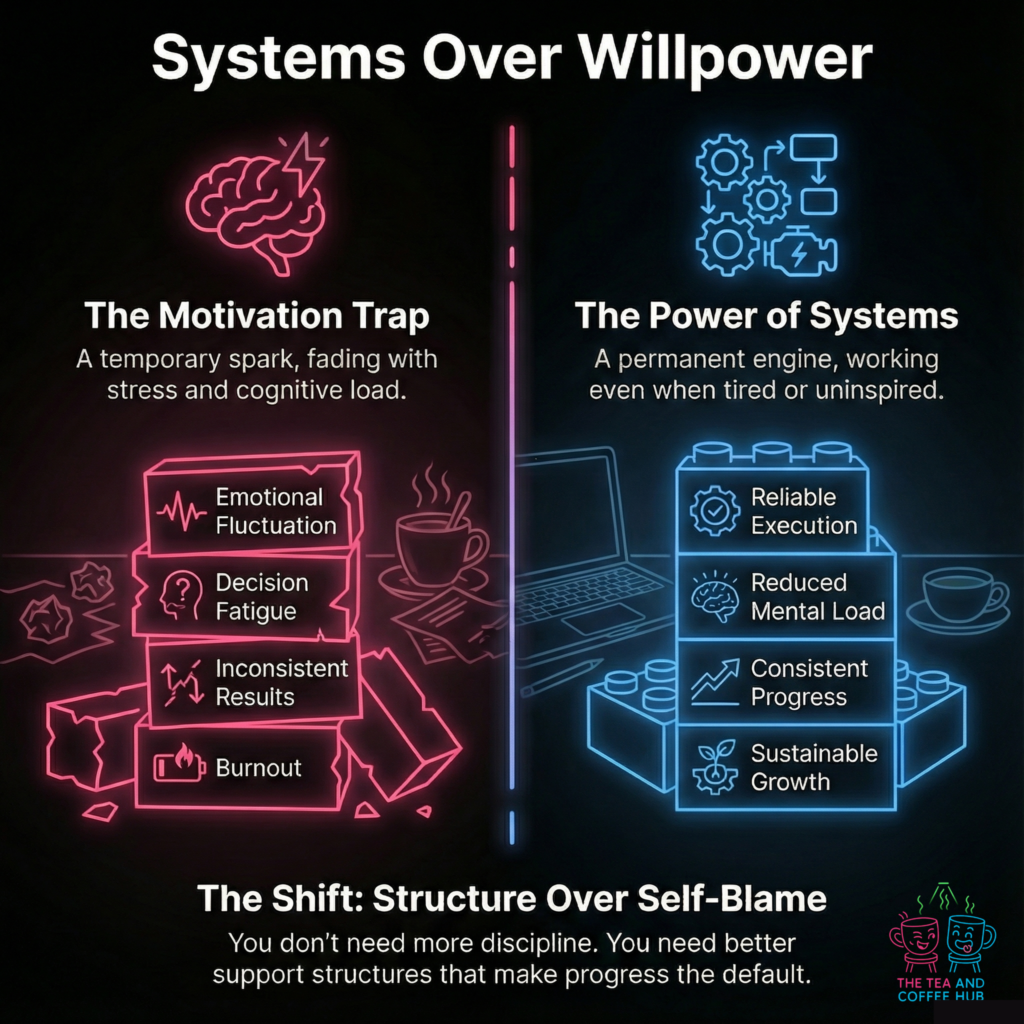
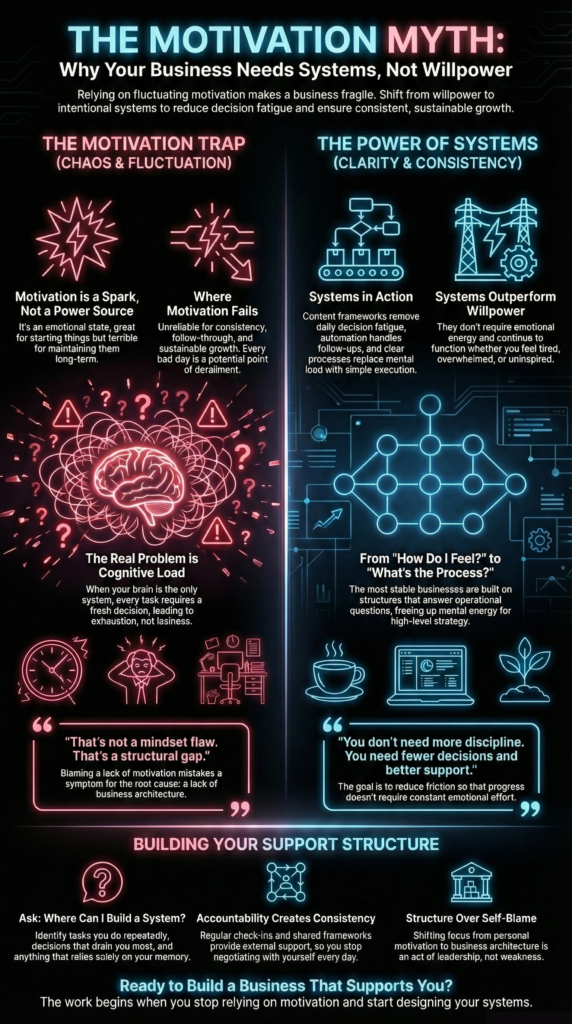
Motivation is a spark, not a power source.
It’s great for:
Starting a business
Launching a new idea
Creating bursts of momentum
It’s terrible for:
Consistency
Follow-through
Long-term growth
When your business depends on motivation alone, every bad night of sleep, client issue, or personal obligation becomes a derailment point.
That’s not a mindset flaw.
That’s a structural gap.
Motivation vs Systems: Why Willpower Isn’t the Problem
Systems don’t require emotional energy.
They don’t care if:
You’re tired
You’re overwhelmed
You’re juggling too many roles
They quietly do the work you’ve already decided matters.
Examples:
A content framework removes daily decision fatigue
Automation handles follow-ups you forget
Clear processes replace mental load with execution
This is why the conversation around motivation vs systems matters so much for small business owners trying to grow without burnout.
The most stable businesses don’t ask, “Do I feel like doing this today?”
They ask, “What’s already set up to support this?”
The Real Reason Motivation Fades
Motivation fades fastest when:
Your brain is the system
Everything requires a fresh decision
Progress depends on remembering instead of structure
That constant cognitive load creates exhaustion, not laziness.
When business owners say, “I just can’t stay consistent,” what they usually mean is:
“I don’t have enough support built around me.”
What to Focus on Instead of Motivation
Rather than trying to feel more motivated, focus on building low-resistance systems.
Start by asking:
What do I do repeatedly that could be templated?
What decisions drain me the most?
What tasks rely on memory instead of process?
You don’t need more discipline.
You need fewer decisions and better support.
This is why frameworks, automation, and accountability matter. They reduce friction so progress doesn’t require constant emotional effort.
Why Accountability Changes Everything
Even the best systems struggle in isolation.
Accountability isn’t about pressure.
It’s about consistency through support.
When you have:
Clear frameworks
Shared language
Regular check-ins
You stop negotiating with yourself every day.
That’s why the Tea & Coffee accountability space exists. Not to push harder, but to hold structure steady while real life happens.
The Shift
Motivation will always rise and fall.
Systems stay.
If your business feels heavier than it should, the solution isn’t more inspiration. It’s better support, clearer structure, and fewer things resting solely on your brain.
That’s not weakness.
That’s leadership.
If you’re ready to stop relying on motivation and start building a business that supports you, this is the work we do inside the Tea & Coffee accountability space.
Structure over self-blame.
Systems over willpower.