You’re Not Lazy, You’re Managing Too Many Roles at Once
You’re not lazy. Most small business owners aren’t stuck because they lack discipline, motivation, or follow-through. They feel behind because they’re managing too many roles at once without structural support.
When everything feels heavy, inconsistent, or mentally exhausting, it’s easy to assume the problem is you. But you’re not lazy, you’re carrying more than one human was ever meant to manage alone.
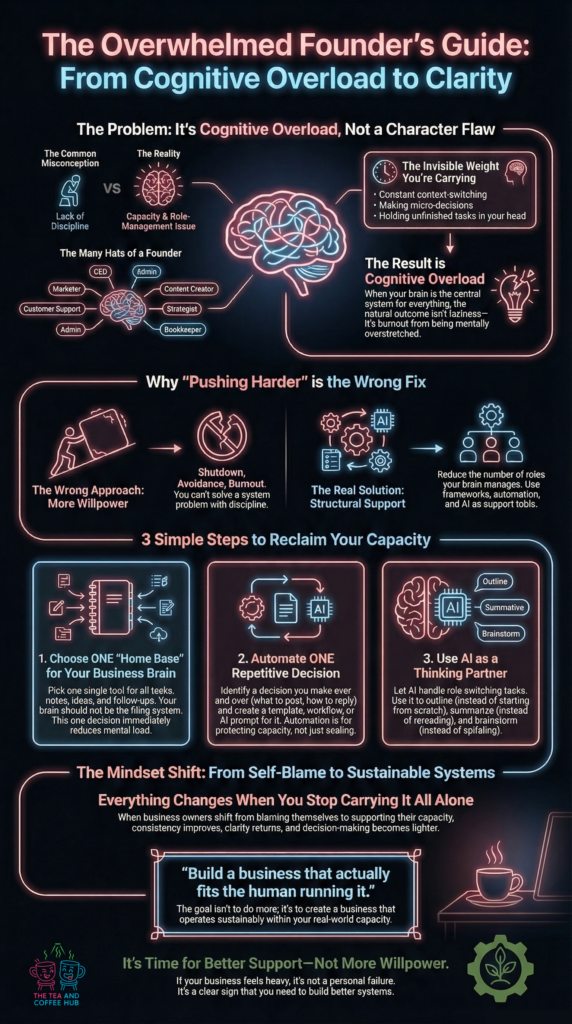
We see this pattern constantly in small business owners: one person trying to be the CEO, marketer, customer support, admin, content creator, strategist, bookkeeper, and decision-maker, all before lunch.
When everything feels heavy, inconsistent, or mentally exhausting, it’s easy to assume something is wrong with you.
But that assumption is wrong.
This isn’t a discipline problem.
It’s a capacity and role management problem.
The Invisible Weight Most Business Owners Carry
Most entrepreneurs never consciously choose to manage this many roles.
It just… happens.
You start the business because you’re good at something. Then emails pile up. Content needs posting. Clients need follow-up. Systems don’t exist yet, so your brain becomes the system.
Over time, your mental load looks like this:
• Switching between strategic thinking and reactive tasks
• Making dozens of micro-decisions every day
• Holding unfinished tasks in your head “for later”
• Being interrupted constantly by notifications, messages, and ideas
None of that shows up on a to-do list, but it drains capacity faster than long work hours ever could.
If you’ve been telling yourself you’re lazy, pause. You’re not lazy, you’re overloaded, unsupported, and expected to function like a full team without systems.
You have to agree, the result isn’t laziness.
It’s cognitive overload.
Why Willpower Won’t Fix This
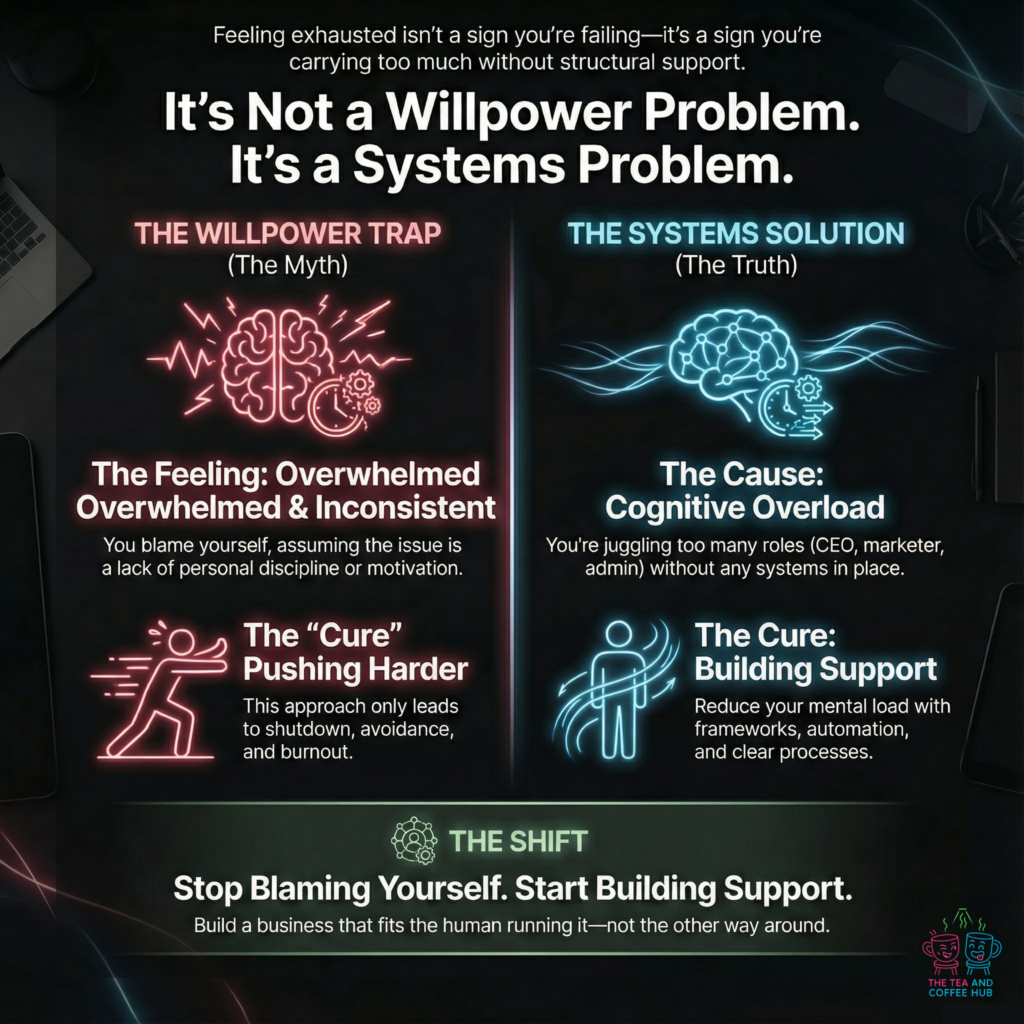
More discipline won’t solve a system problem.
In fact, pushing harder often makes things worse. When capacity is stretched, adding pressure creates shutdown, avoidance, or burnout.
The solution isn’t to “try harder.”
It’s to reduce the number of roles your brain has to manage at once by using frameworks, automation, and AI as support tools, not productivity guilt machines.
3 Things You Can Do Right Now to Streamline Your Busines
These are not big overhauls. They’re capacity-friendly shifts you can implement today.
1. Choose One “Home Base” for Your Business Brain
Most overwhelm comes from scattered tools.
Decide on one place where everything lives:
• Tasks
• Notes
• Content ideas
• Links
• Follow-ups
Whether that’s a project management tool, a notes app, or a CRM, the key is one source of truth.
Your brain should not be the filing system.
This single decision immediately reduces mental load and decision fatigue.
2. Automate One Repetitive Decision
Look for something you decide over and over:
• What to post
• How to reply to inquiries
• When to follow up
• What happens after someone signs up
Then automate just that one thing.
This could be:
• A saved email reply
• A simple workflow
• An AI prompt you reuse
• A scheduled content framework
Automation isn’t about scaling fast.
It’s about protecting capacity.
3. Use AI as a Thinking Partner, Not a Replacement
AI works best when it reduces role-switching, not when it replaces your voice.
Use it to:
• Outline instead of starting from scratch
• Summarize instead of rereading
• Brainstorm instead of spiraling
• Organize instead of remembering
When used intentionally, AI acts like an extra set of hands, not another thing to manage.
The Real Shift: From Self-Blame to Structural Support, Because You're Not Lazy!
Once business owners stop blaming themselves and start supporting their capacity, everything changes.
Consistency improves.
Clarity returns.
Decision-making becomes lighter.
Not because they suddenly became more disciplined, but because they stopped carrying everything alone.
This is exactly the work Karen and Steve focus on inside the Tea & Coffee Hub Accountability Group: helping business owners simplify, structure, and build sustainable systems without pressure or performative hustle.
It’s not about doing more.
It’s about building a business that actually fits the human running it.
If your business feels heavy, it’s not a personal failure.
It’s a sign that it’s time for better support, not more willpower.